Art of Solitaire - Card Games
- 4.0
- Rating
- 1.00M
- Installs
- Free
- Price

 Analysis by App-foxy
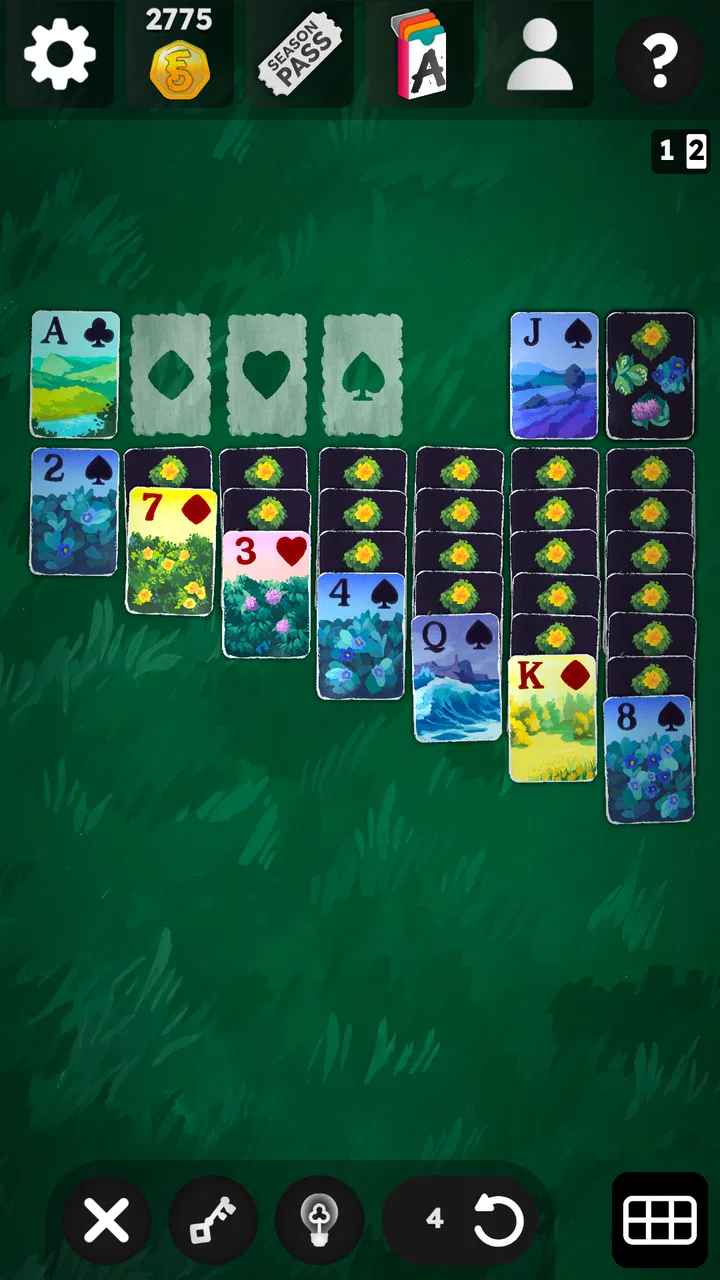
I came away from Art of Solitaire - Card Games with the feeling that it is trying to make familiar patience games feel more like a small, relaxing art object than a plain deck of cards. That approach does not replace the appeal of classic solitaire, but it gives the experience a more distinctive mood. I found it easiest to enjoy in short sessions, when I wanted something quiet and immediately understandable rather than a demanding strategy game.
This is a free card game from Flick Games - Solitaire & Patience Card Games. Its main attraction is the selection of recognizable formats, including Klondike Solitaire, Spider, and Pyramid, alongside collaborations connected with Inscryption and Monument Valley. That combination makes it more interesting than a single-mode solitaire app, although the experience still depends heavily on whether you enjoy repeating card puzzles over time.
What makes the card experience stand out
The first thing I noticed is the balance between familiarity and presentation. Klondike gives the app an instantly accessible starting point: if you have played traditional solitaire on a computer or with physical cards, you can understand the basic objective without a tutorial-heavy introduction. Spider changes the rhythm by asking you to manage sequences more carefully, while Pyramid offers a different kind of matching challenge. Moving between them helps prevent the app from feeling like one puzzle copied into several menus.
You May Also Like

 Blood Strike: 2.5 Anniversary
Blood Strike’s Loadouts Turn Every Drop Into a Tactical Gamble
A close look at Blood Strike’s custom loadouts: how fast access to signature weapons reshapes its battle royale rhythm, rewards preparation, and narrows the gap between fights.

 Pandora - Music & Podcasts
Pandora’s Music Is Easy to Start, but Harder to Recover
Pandora’s strength is its low-effort path from a seed to a station. Its weak spot is how much confidence it asks you to place in connection, setup, and quiet recovery.

 8 Ball Pool
 Is Built on Rivalries, Rematches, and Routine
A close look at the rivalries, rematches, shared routines, and unanswered safety questions that turn a quick pool match into a persistent mobile community.

 Samsung Music
’s Quiet Strength Is Playing What You Already Own
Its reach comes less from spectacle than from dependable access to a personal library. That simplicity is both the app’s strongest retention engine and its ceiling.

 AccuWeather: Weather Radar
AccuWeather Review: A Quick, Clear Forecast for Everyday Decisions
For everyday plans, the best forecast is the one you can understand quickly. AccuWeather makes rain timing, radar, and local conditions easy to act on, with a few trade-offs.

 Hill Climb Racing
Why Hill Climb Racing Still Turns Crashes Into One More Run
A tiny car, a bumpy hill and one more upgrade: Hill Climb Racing keeps resurfacing because its simple chaos makes every near-miss feel personal.
More From Our News Desk



I also think the themed collaborations are more meaningful here than a simple decorative reskin would be. Inscryption and Monument Valley carry very different identities, so their presence suggests that the game is interested in atmosphere as well as mechanics. I would not install this expecting a full-length version of either title. Instead, I see those collaborations as a way to give familiar solitaire sessions a stronger visual personality and to attract players who normally find standard card tables a little plain.
The result is particularly effective when I play without rushing. Solitaire is often used as background entertainment, but the art direction encourages me to pay a little more attention to the table, card movement, and overall presentation. That does not transform every hand into a memorable event, yet it makes the routine feel less anonymous. The strongest reason to try it is the meeting of classic solitaire rules and a more curated visual mood.
The three main game types also serve different everyday moods. Klondike suits a quick break because the rules are familiar and the decision-making is easy to enter. Spider is better when I want to think several moves ahead and accept that a careless choice can make the rest of the layout awkward. Pyramid is useful when I want a lighter matching exercise rather than a long sequence-building problem. Having these choices in one place means I can change the kind of concentration I need without opening another game.
How I would use it during an ordinary day
Imagine having ten minutes before an appointment or while waiting for a friend. I would begin with Klondike because it has the least mental overhead. If the session starts to feel too automatic, I would switch to Spider and treat it as a more deliberate puzzle. That small change is more useful than it sounds: it lets the same app work as both a casual distraction and a modest test of planning, without asking me to learn an entirely new control scheme.
For longer sessions, I would avoid choosing a mode simply because it is familiar. Spider rewards looking for future openings instead of immediately making the most obvious move. In Pyramid, I would pay attention to which cards are blocking access to the lower layers, rather than clearing any available pair without considering what that reveals. These habits are not secret mechanics, but they are practical ways to get more depth from the included formats than a quick tap-through approach provides.
Another useful routine is to alternate a comfortable mode with a more demanding one. A few rounds of Klondike can work as a gentle warm-up, followed by Spider when I want a puzzle that holds my attention. This makes the app feel less repetitive than playing one format continuously. It also helps reveal an important trade-off: the variety is genuine, but it comes from different solitaire structures, not from a broad collection of unrelated card games.
Where the collaborations help, and where they do not
The Inscryption and Monument Valley connections are likely to be the most appealing element for players who care about game identity. They give the app a conversation point that ordinary solitaire collections usually lack. I appreciate that the concept does not rely solely on a generic green table and a standard deck presentation. The themed material makes the game feel selected and designed rather than assembled as a utility.
At the same time, I would keep expectations measured. Someone looking for the unsettling card-game tension associated with Inscryption or the spatial puzzle design associated with Monument Valley may find the solitaire setting much more restrained. The collaborations add flavor, but they do not turn this into either of those games. I see them as an invitation to explore a familiar format through a different visual lens, not as a substitute for the original experiences.
This distinction matters when deciding whether the app is right for you. If you want a straightforward solitaire collection with a little more character, the collaborations are a strong bonus. If you are downloading it mainly for a deep crossover campaign, story content, or a dramatic reinvention of card games, you may be disappointed. The core remains patience, and the quality of the experience depends on how much pleasure you already get from arranging cards.
Practical details that affect the decision
The game is free to install and is suitable for Everyone, which makes it easy to recommend as a low-commitment try. It has passed one million installs, and its average rating is 4.0 from around sixteen thousand ratings, with roughly eighteen hundred written reviews. Those figures suggest a substantial audience and a generally positive reception, while also leaving room for the normal differences in taste that surround casual games.
On Android, it requires version 8.0 or later. The current version is 3.02.06, so anyone using an older device should check compatibility before planning around it. I consider the requirement reasonable for a modern card game, but it still matters if you keep an older phone specifically for simple offline-style entertainment. The app is not aimed only at new flagship hardware, yet the operating-system requirement is worth noticing.
There are in-app purchases ranging from $0.99 to $34.99 per item. Because the initial download is free, I would approach the game with the same caution I use for any free casual title: start by seeing whether the basic experience already suits you, then decide whether optional spending adds enough value. I would not treat the purchase range as a reason to avoid the game automatically, but I also would not assume that every extra item is necessary for enjoying Klondike, Spider, or Pyramid.
One practical question many players have is whether a solitaire game is suitable for very short sessions. In this case, yes, especially with Klondike. The familiar rules make it possible to begin immediately, and the other modes provide a way to extend the session when I want more thought. It is less suitable if I need a game with a clear narrative stopping point, because a card layout can encourage me to keep playing just to see whether the next hand turns out better.
Another question is whether it works for beginners. I think it does, provided the player already understands basic card order or is willing to learn through play. Klondike is the natural entry point, while Spider and Pyramid can be introduced gradually. I would not hand this to someone seeking a highly guided tutorial experience, but the familiar formats make the learning curve much gentler than in a specialized strategy card game.
The friction I would want new players to know about
The main weakness is not a broken rule or an obvious lack of variety; it is the possibility of repetition. Even with three recognizable modes and themed presentation, the underlying activity remains a cycle of dealing, arranging, and trying again. After several sessions, the artwork may keep the app pleasant, but it cannot remove the fact that the decision space is narrower than in a collectible card game or a broader puzzle collection.
That limitation becomes more noticeable for players who need constant novelty. If I want evolving objectives, character progression, competitive matchmaking, or a campaign that changes the stakes, this is not where I would spend my time. A traditional solitaire app with an enormous set of variations might be a better fit for someone who values quantity above presentation. Conversely, a story-driven card game would suit a player who wants each session to feel connected to a larger journey.
There is also a subtle trade-off between atmosphere and efficiency. A purely functional solitaire tool can feel faster because every element exists only to help clear the table. Here, the artistic identity is part of the appeal, so players who want the most stripped-down interface may prefer a simpler alternative. I personally think the visual character earns its place, but I understand why someone focused on speed might see it as unnecessary decoration.
For players who are sensitive to spending prompts, the free-to-play structure deserves attention. The presence of purchases does not by itself make the game unsuitable, but I would set a personal limit before exploring optional content. That is especially sensible for a relaxing game, where the goal is to unwind rather than feel nudged into improving the experience through repeated small payments. The free entry point is useful; the best value depends on staying intentional about extras.
Who will get the most from it
I would recommend this game first to people who already enjoy Klondike but want something with more personality than a bare-bones card table. It is also a good match for players who move between different kinds of solitaire instead of committing to one format. The Inscryption and Monument Valley collaborations make it more appealing to anyone who notices visual design and game culture, even if the actual play remains rooted in classic patience rules.
It can work well for a family member who wants an approachable card game, since the age rating is Everyone and the basic formats are widely understood. I would still explain that the app is designed around solo play and repeated puzzles, not social card-table interaction. Someone looking for a game to play directly against friends should choose a product built around multiplayer first.
I would skip it if my priority were competitive depth, a large strategic card system, or a story campaign. I would also look elsewhere if I wanted a completely minimal solitaire utility with no artistic framing. The app's identity is precisely the combination of recognizable card play and curated presentation, so removing either side removes much of the reason to choose it over a standard alternative.
For experienced solitaire players, the question is not whether the rules are new. They probably are not. The question is whether the presentation, mode switching, and collaborations make familiar decisions pleasant enough to revisit. In my experience, they do, particularly in short sessions. The game is at its best when I treat it as a calm design-led version of a classic pastime rather than expecting it to reinvent the genre.
My verdict after using the collection
Art of Solitaire - Card Games succeeds because it understands that solitaire does not need complicated systems to be enjoyable, but it does benefit from a clear sense of style. Klondike, Spider, and Pyramid provide a dependable foundation, while the Inscryption and Monument Valley collaborations give the collection a more memorable identity. I found the app easy to return to when I wanted a quiet puzzle that could last a few minutes or fill a longer pause.
Its limitations are equally clear. The core loop can become repetitive, the artistic approach will not appeal to everyone, and the purchase options mean I would pay attention to how I use the free version before spending. Players wanting multiplayer competition, narrative progression, or a much larger range of card formats should consider another category of game. Those are not small differences; they define the experience.
For me, this is a worthwhile recommendation for casual card-game fans who want familiar rules presented with more care and atmosphere. I would start with Klondike, use Spider when I want deeper planning, and keep Pyramid available for lighter sessions. If that pattern sounds appealing, the free download makes trying it simple. If solitaire itself already feels repetitive, the collaborations may not be enough to change your mind.
Overall, I see it as a polished, approachable choice for quiet solo play rather than an ambitious replacement for every kind of card game. It gives classic patience a distinctive setting, offers enough mode variety for everyday use, and remains honest about its own narrow focus through the simplicity of its design. That makes it easy for me to recommend to the right player, while also making the wrong audience fairly easy to identify.
FAQs for Art of Solitaire - Card Games
01What is Art of Solitaire - Card Games?
Art of Solitaire - Card Games is a relaxing solitaire experience designed for players who enjoy classic card gameplay with a more polished visual presentation. It typically focuses on familiar solitaire rules, simple controls, and attractive artwork or themed backgrounds. The game is suitable for short sessions, whether you want to unwind for a few minutes or complete several card challenges in one sitting.
02How do you play Art of Solitaire - Card Games?
The main gameplay follows the familiar objective of arranging cards according to solitaire rules, usually by building foundation piles in sequence while organizing cards on the tableau. Players tap or drag cards to make moves, depending on their device and control preferences. If you already know Klondike-style solitaire, the basic mechanics should feel immediately recognizable, although available modes and rules may vary by version.
03Is Art of Solitaire - Card Games free to download?
Art of Solitaire - Card Games can generally be downloaded without an upfront purchase, but the exact business model may include advertisements, optional purchases, or premium features. Before installing, check the Google Play Store or Apple App Store listing for current pricing and in-app purchase details. This is especially important if you want an ad-free experience or access to additional themes, hints, or customization options.
04Does the game require an internet connection?
Many solitaire games are designed to work offline, allowing you to play during travel or in places with limited connectivity. However, an internet connection may still be needed for advertisements, cloud features, updates, leaderboard functions, or restoring purchases. After installation, it is worth testing the game in airplane mode to see which features remain available without an active connection.
05Is Art of Solitaire - Card Games suitable for all ages?
The simple card-based gameplay makes Art of Solitaire - Card Games generally suitable for a broad audience, including casual players and people who prefer slower-paced games. Parents should still review the store rating, privacy information, and advertising practices before allowing children to play. If the app includes optional purchases or third-party advertisements, parental controls may be useful on shared devices.
Pros
- Simple rules make it suitable for both beginners and casual players.
- Multiple solitaire variations provide more variety than a single-mode game.
- Short rounds work well for quick breaks or daily play sessions.
- Card controls are generally easy to understand on a touchscreen.
- Offline play can be convenient when you have no internet connection.
Cons
- Some features or card designs may require in-app purchases.
- Gameplay can feel repetitive once familiar layouts become predictable.
- Ads may interrupt play
- especially in the free version.
- Random deals can occasionally feel frustrating or difficult to complete.
- Advanced players may find the strategy options less challenging over time.

Art of Solitaire - Card Games
Gallery